
The platform’s first Policy Brief analyses the integration of water services and energy neutrality, exploring the potential to recover energy from water networks to power urban heating systems.
Networking industrial expertise, research, and local governance to tackle the challenges of the ecological transition systematically: this is the core objective behind SHIFT, a platform launched by Gruppo CAP that brings together industrial and technological operators, research centres, and spatial planning bodies to develop integrated management models for environmental infrastructure.
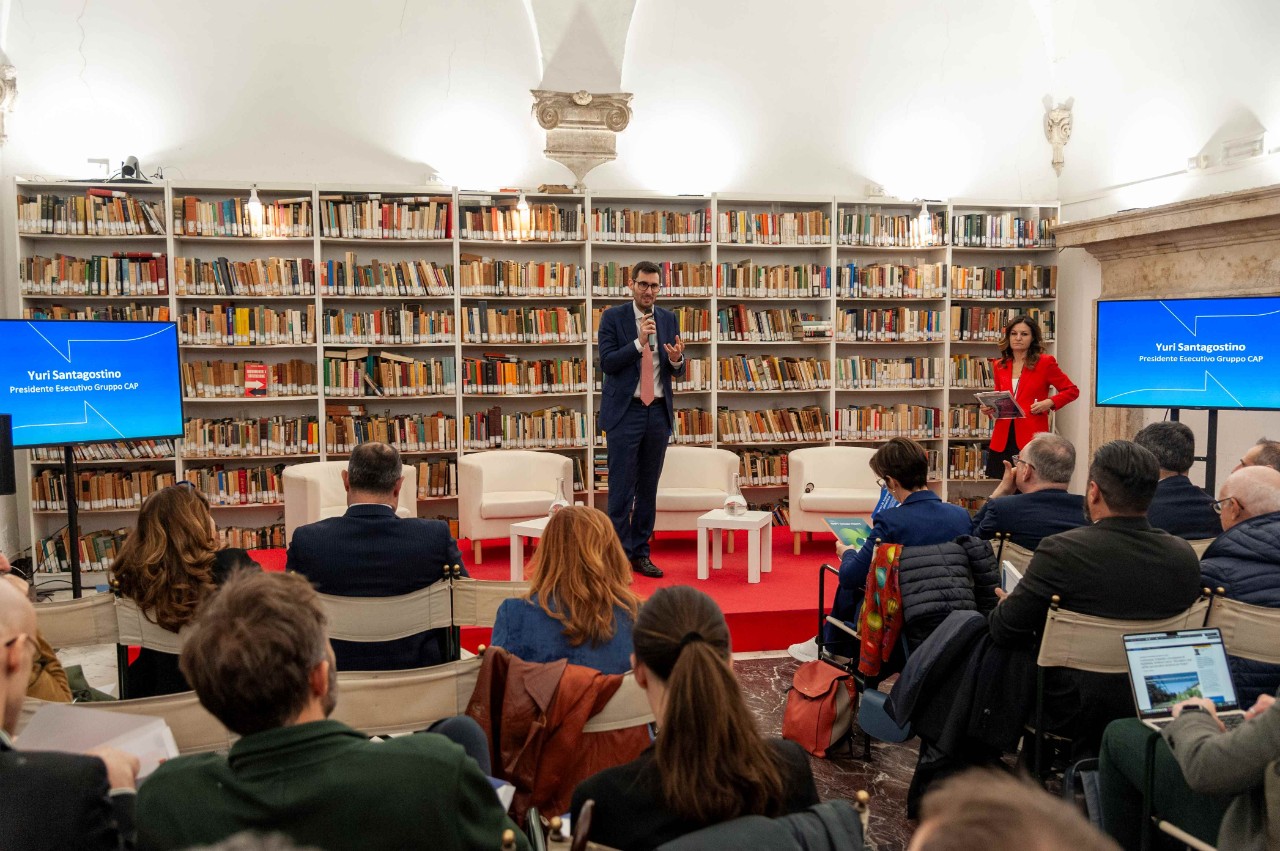
The project was presented today in Rome at the Istituto Luigi Sturzo during a national event that brought together representatives from government institutions, industry, and the scientific community.
The creation of SHIFT addresses an increasingly evident need in both European and national debates, namely to confront climate, energy, and industrial challenges through cross-sector synergies and complementary skills, rather than through isolated, siloed measures. Within this framework, environmental infrastructure – water, energy, waste, and resource recovery – becomes a strategic asset for the competitiveness and resilience of local communities.
Water and energy are not merely environmental concerns: they are key drivers of the country’s economic and productive system. In fact, up to 20% of Italy’s national GDP is directly linked to the availability of water resources. The broader water sector generates significant economic value across the entire supply chain, with a multiplier effect of 2.8 – proving its powerful leverage over other productive industries.
SHIFT was established with this precise mission: to foster collaboration between public and private stakeholders, promote technological innovation, and build new integration models for environmental services, thereby contributing to the development of scalable solutions for the green transition.
The platform’s activities are structured around three strategic pillars, which reflect the main directions of the ongoing transformation:
· climate transition, with a particular emphasis on Nature-Based Solutions, the development of Aquatech technologies, and pathways toward energy neutrality across environmental infrastructure;
· bioeconomy, featuring initiatives aimed at waste water reuse and quality, as well as the recovery of organic matter, within a circular resource management framework;
· synergy between water and waste, aiming to develop integration models combining the Integrated Water Service, energy systems, district heating networks, and waste management supply chains to ensure increasingly efficient and sustainable management of environmental infrastructure.
Through these work streams, SHIFT aims to become a permanent forum for dialogue and co-design, capable of combining industrial experience, technological innovation, and the strategic vision of local governments.
With the launch of SHIFT, Gruppo CAP reinforces its commitment to promoting alliances between industry, research, and institutions, transforming environmental infrastructure into an engine for innovation, sustainability, and national development.
The First Policy Brief: Synergies Between Water and Energy
The platform’s operational debut coincides with the presentation of its first Policy Brief, which focuses on the opportunities for integrating water infrastructure with urban energy systems.
The document explores the potential for recovering thermal energy from waste water, demonstrating how treatment plants can become genuine ‘energy mines’. Indeed, water cycle networks maintain a stable temperature between 10 and 20 °C throughout the year – a resource currently underutilised that can be harnessed via industrial heat pumps to feed urban district heating networks. Integrating the Integrated Water Service with district heating provides the most concrete example of how environmental infrastructure can evolve from siloed service systems into urban energy platforms; however, to scale these models, SHIFT highlights the urgent need to update the national regulatory framework to overcome current economic barriers.
The Policy Brief calls on the Government to establish regulatory parity between recovered heat and electricity in relation to the EU’s 2045 climate targets, alongside tax exemptions for the electricity used to power thermal recovery processes. At the same time, SHIFT advocates for recognising the strategic importance of infrastructure integration projects, along with a drastic streamlining of permit procedures – an essential step to offset the high costs of network installation and ensure the deployment of funding ahead of the National Recovery and Resilience Plan (NRRP) deadlines.
A Multi-Stakeholder Alliance for Regulatory Quality
The strength of SHIFT lies in its multi-stakeholder nature and its ability to connect diverse skillsets across the entire ecological transition value chain.
The project involves the participation of entities such as Utilitalia, Fondazione Utilitatis, and Aqua Pubblica Europea, alongside technology and planning partners including A2A Calore e Servizi, ALA, Gruppo Allevi, Aquanexa, Bioforcetech, Gruppo CAP, Isle Utilities, Tecno Habitat, LAND, the Milan Association of Engineers, Politecnico di Milano, Rice House, ARS Ambiente, and Ascolto Attivo.
It is thanks to this plurality of voices that SHIFT can act as a system enabler, providing public decision-makers with technical analyses and operational proposals for an ecological transition that is not just a collection of isolated sector interventions, but an integrated vision for the development of environmental and urban infrastructure.